正確的なNSE5_FSW_AD-7.6日本語試験情報 &資格試験におけるリーダーオファー &実用的なNSE5_FSW_AD-7.6受験記
Wiki Article
さらに、JPNTest NSE5_FSW_AD-7.6ダンプの一部が現在無料で提供されています:https://drive.google.com/open?id=10cLmF-1Ah-esHnVZ6_tf9yaU-F5vHUfG
中国でこのような諺があります。天がその人に大任を降さんとする時、必ず先ず困窮の中におきてその心志を苦しめ、その筋骨を労し、その体膚を餓やし、その身を貧困へと貶めるのである。この話は現在でも真です。しかし、成功には方法がありますよ。正確な選択をしたら、そんなに苦労しなくても成功することもできます。JPNTestのFortinetのNSE5_FSW_AD-7.6試験トレーニング資料はIT職員を対象とした特別に作成されたものですから、IT職員としてのあなたが首尾よく試験に合格することを助けます。もしあなたは試験に準備するために知識を詰め込み勉強していれば、間違い方法を選びましたよ。こうやってすれば、時間とエネルギーを無駄にするだけでなく、失敗になるかもしれません。でも、今方法を変えるチャンスがあります。早くJPNTestのFortinetのNSE5_FSW_AD-7.6試験トレーニング資料を買いに行きましょう。その資料を手に入れたら、異なる人生を取ることができます。運命は自分の手にあることを忘れないでください。
Fortinet NSE5_FSW_AD-7.6 認定試験の出題範囲:
| トピック | 出題範囲 |
|---|---|
| トピック 1 |
|
| トピック 2 |
|
| トピック 3 |
|
| トピック 4 |
|
試験NSE5_FSW_AD-7.6日本語試験情報 & 認定するNSE5_FSW_AD-7.6受験記 | 大人気NSE5_FSW_AD-7.6模擬体験
時代の発展に伴い、人間的な文明が発展し、JPNTestも発展しています。JPNTestは君の早くFortinetのNSE5_FSW_AD-7.6認定試験に合格するために、きみのもっと輝い未来のために、君の他人に羨ましいほど給料のために、ずっと努力しています。長年の努力を通じて、JPNTestのFortinetのNSE5_FSW_AD-7.6認定試験の合格率が100パーセントになっていました。JPNTestを選ぶなら、成功を選ぶのに等しいです。
Fortinet NSE 5 - FortiSwitch 7.6 Administrator 認定 NSE5_FSW_AD-7.6 試験問題 (Q61-Q66):
質問 # 61
Refer to the exhibit.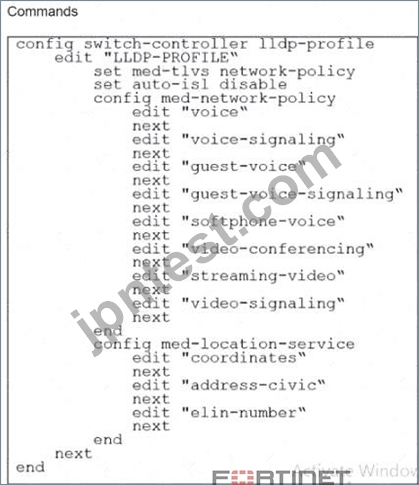
The profile shown in the exhibit is assigned to a group of managed FortiSwitch ports, and these ports are connected to endpoints which are powered by PoE.
Which configuration action can you perform on the LLDP profile to cause these endpoints to exchange PoE information and negotiate power with the managed FortiSwitch?
- A. Create new a LLDP-MED application type to define the PoE parameters.
- B. Assign a new LLDP profile to handle different LLDP-MED TLVs.
- C. Define an LLDP-MED location ID to use standard protocols for power.
- D. Add power management as part of LLDP-MED TLVs to advertise.
正解:D
解説:
To cause endpoints to exchange PoE information and negotiate power with the managed FortiSwitch via LLDP, you should configure the LLDP profile to include power management in the advertised LLDP-MED TLVs. Here are the steps:
* Access the LLDP Profile Configuration:Start by entering the LLDP profile configuration mode with the command:
config switch-controller lldp-profile
edit "LLDP-PROFILE"
* Enable MED-TLVs:Ensure that MED-TLVs (Media Endpoint Discovery TLVs) are enabled. These TLVs are used for extended discovery relating to network policies, including PoE, and are essential for PoE negotiation. They include power management which is crucial for the negotiation of PoE parameters between devices. The command to ensure network policies are set might look like:
set med-tlvs network-policy
* Add Power Management TLV:Specifically add or ensure the power management TLV is part of the configuration. This will advertise the PoE capabilities and requirements, enabling dynamic power allocation between the FortiSwitch and the connected devices (like VoIP phones or wireless access points). This can typically be done within the network-policy settings:
config med-network-policy
edit <policy_index>
set poe-capability
next
end
* Save and Apply Changes:Exit the configuration blocks properly ensuring changes are saved:
End
* Verify Configuration:It's always good practice to verify that your configurations have been applied correctly. Use the appropriateshoworgetcommands to review the LLDP profile settings.
By adding the power management as part of LLDP-MED TLVs, the FortiSwitch will be able to communicate its power requirements and capabilities to the endpoints, thereby facilitating a dynamic power negotiation that is crucial for efficient PoE utilization.
References:For more detailed information and additional configurations, you can refer to the FortiSwitch Managed Switches documentation available on Fortinet's official documentation site:Fortinet Product Documentation
質問 # 62
How does FortiGate handle configuration of flow tracking sampling if you export the settings to a managed FortiSwitch stack with sampling mode set to perimeter is true?
- A. FortiGate configures and enables egress sampling on all management interfaces.
- B. FortiGate configures FortiSwitch to perform ingress sampling on all switch interfaces.
- C. FortiGate configures FortiSwitch to perform ingress sampling on all switch interfaces, except ICL and ISL interfaces.
- D. FortiGate configures and enables flow sampling on FortiSwitch but does not change existing sampling settings of interfaces.
正解:C
解説:
When FortiGate exports configuration settings to a managed FortiSwitch stack with sampling mode set to
"perimeter is true," the behavior is:
* B. FortiGate configures FortiSwitch to perform ingress sampling on all switch interfaces, except ICL and ISL interfaces.This setting ensures that all incoming traffic on normal operational ports is sampled for monitoring and analysis purposes, but it excludes the inter-chassis link (ICL) and inter- switch link (ISL) interfaces from sampling. These exclusions are typically made to prevent the duplication of sampled data and to reduce unnecessary load on the monitoring system, as these links often carry traffic already monitored at other points.
Options A and D are incorrect because they either generalize the sampling across all interfaces without exceptions or incorrectly specify egress sampling on management interfaces. Option C is also incorrect as FortiGate can modify existing sampling settings to fit the perimeter-based configuration requirement.
質問 # 63
Which two statements about DHCP snooping enabled on a FortiSwitch VLAN are true? (Choose two.)
- A. Enabling DHCP snooping on a FortiSwitch VLAN ensures requests and replies are seen by all DHCP servers.
- B. By default, all FortiSwitch ports are set to forward client DHCP requests to untrusted ports.
- C. Settings related to DHCP option 82 are only configurable through the CLI
- D. switch-controller-dhcp-snooping-verify-mac verifies the destination MAC address to protect against DHCP exhaustion attacks.
正解:C、D
解説:
* Switch-controller-dhcp-snooping-verify-mac verifies the destination MAC address to protect against DHCP exhaustion attacks (B): This feature of DHCP snooping helps prevent DHCP exhaustion attacks by ensuring that the destination MAC addresses in DHCP packets match the MAC addresses learned by the switch. This check helps prevent attackers from overwhelming the DHCP server with requests from spoofed MAC addresses.
* Settings related to DHCP option 82 are only configurable through the CLI (D): DHCP Option 82 is used for "agent information," and it's typically used in network environments where additional information between DHCP clients and servers is necessary for policy and billing purposes.
Configuration of these settings in FortiSwitch is only available through the Command Line Interface (CLI), not the Graphical User Interface (GUI).
質問 # 64
Which statement about the IGMP snooping querier when enabled on a VLAN is true?
- A. All other indirectly connected switches will be unable to get IGMP multicast traffic.
- B. The setting can only be enabled using the FortiSwitch CLI.
- C. IGMP reports on the VLAN are forwarded to all switch ports.
- D. Active multicast receiver entries are aging on each IGMP query sent on the VLAN
正解:D
解説:
Active multicast receiver entries are aging on each IGMP query sent on the VLAN (A): When IGMP snooping querier is enabled on a VLAN, it functions to manage multicast traffic within the VLAN by keeping track of multicast group memberships. The IGMP querier sends queries to determine which ports require the multicast traffic. The multicast receiver entries, which are entries that indicate which devices have requested the multicast data, age or time out based on these IGMP queries. Each query refreshes active connections but ages out entries that no longer respond, helping to ensure that multicast traffic is only sent to ports with active receivers.
質問 # 65
Refer to the exhibit.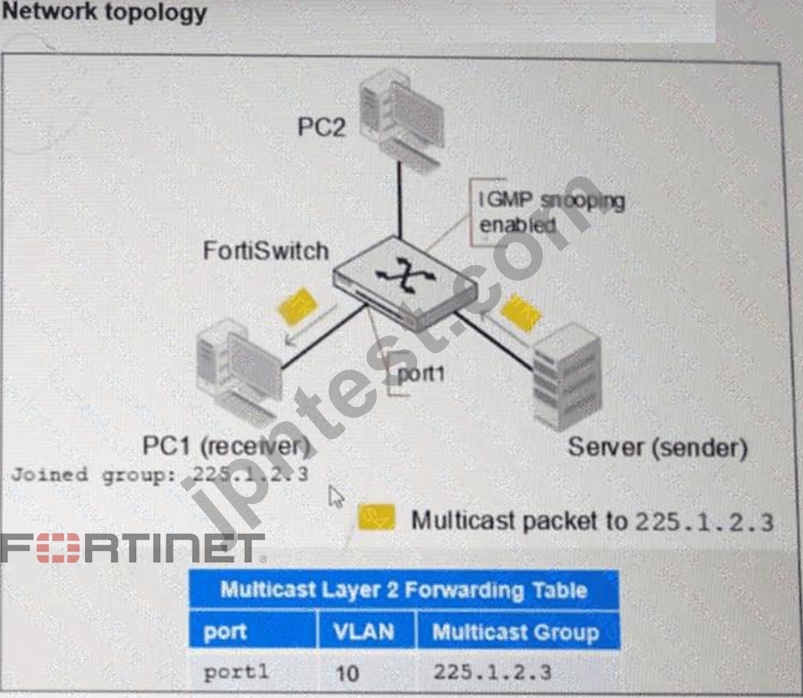
PC1 connected to port1 has joined multicast group 225.1.2.3 on VLAN 10 with IGMP snooping enabled.
What will happen if you disable IGMP snooping on FortiSwitch? (Choose one answer)
- A. Multicast traffic will stop until a multicast receiver is detected.
- B. PC1 will be removed from the multicast group 225.1.2.3.
- C. The FortiSwitch will stop processing IGMP report join messages.
- D. Multicast traffic for 225.1.2.3 will be flooded to all ports.
正解:D
解説:
According to theFortiSwitchOS 7.6 Administration Guideand theFortiSwitch 7.6 Study Guide, Internet Group Management Protocol (IGMP) snooping is a Layer 2 mechanism that allows a switch to "listen" to IGMP conversations between hosts and routers to maintain a map of which ports require specific multicast streams. When IGMP snooping is enabled, the switch populates aMulticast Layer 2 Forwarding Table(as shown in the exhibit), which ensures that multicast traffic is only forwarded to ports where a receiver has explicitly requested it (e.g., PC1 on port1).
When IGMP snooping isdisabled, the switch no longer maintains this granular forwarding table. By default, a Layer 2 switch that is not performing IGMP snooping treats multicast traffic as if it werebroadcast traffic.
Consequently, instead of being intelligently forwarded only to the interested receiver (PC1), the multicast traffic for group 225.1.2.3 will beflooded to all portswithin the same VLAN (VLAN 10). This means PC2, even if it has not joined the group, will receive the multicast packets at the physical layer, leading to unnecessary bandwidth consumption and increased CPU load on unintended recipients.
The documentation explicitly states that disabling IGMP snooping reverts the switch to a "flood-all" behavior for multicast frames within the broadcast domain. Option A is incorrect because the host (PC1) remains a member of the group; only the switch's forwarding logic changes. Option B is incorrect as the switch may still see the messages but will not act on them to prune ports. Option D is incorrect as disabling the feature removes the prune/stop mechanism, causing traffic to flow everywhere rather than stopping.
質問 # 66
......
NSE5_FSW_AD-7.6試験トレントを購入した後、10分以内にできるだけ早く製品をお届けすることを保証します。したがって、長時間待つ必要がなく、配達時間や遅延を心配する必要はありません。 NSE5_FSW_AD-7.6準備トレントをすぐにオンラインで転送します。このサービスは、NSE5_FSW_AD-7.6テストブレインダンプが人々の心をつかむことができる理由でもあります。さらに、NSE5_FSW_AD-7.6トレーニングガイドで20〜30時間だけ学習すれば、NSE5_FSW_AD-7.6試験に自信を持って合格することができます。
NSE5_FSW_AD-7.6受験記: https://www.jpntest.com/shiken/NSE5_FSW_AD-7.6-mondaishu
- NSE5_FSW_AD-7.6日本語 ➿ NSE5_FSW_AD-7.6試験問題集 ???? NSE5_FSW_AD-7.6問題数 ⏹ ➽ www.jptestking.com ????の無料ダウンロード「 NSE5_FSW_AD-7.6 」ページが開きますNSE5_FSW_AD-7.6試験勉強過去問
- いま安心でFortinet NSE5_FSW_AD-7.6認定試験を受験することができる ???? 【 www.goshiken.com 】は、➤ NSE5_FSW_AD-7.6 ⮘を無料でダウンロードするのに最適なサイトですNSE5_FSW_AD-7.6ブロンズ教材
- NSE5_FSW_AD-7.6試験の準備方法|効果的なNSE5_FSW_AD-7.6日本語試験情報試験|正確的なFortinet NSE 5 - FortiSwitch 7.6 Administrator受験記 ???? ⇛ www.shikenpass.com ⇚サイトにて✔ NSE5_FSW_AD-7.6 ️✔️問題集を無料で使おうNSE5_FSW_AD-7.6復習テキスト
- NSE5_FSW_AD-7.6日本語版サンプル ???? NSE5_FSW_AD-7.6試験情報 ???? NSE5_FSW_AD-7.6試験情報 ???? 時間限定無料で使える▷ NSE5_FSW_AD-7.6 ◁の試験問題は➠ www.goshiken.com ????サイトで検索NSE5_FSW_AD-7.6ダウンロード
- NSE5_FSW_AD-7.6試験の準備方法|効果的なNSE5_FSW_AD-7.6日本語試験情報試験|正確的なFortinet NSE 5 - FortiSwitch 7.6 Administrator受験記 ???? ⏩ NSE5_FSW_AD-7.6 ⏪の試験問題は➥ www.xhs1991.com ????で無料配信中NSE5_FSW_AD-7.6ブロンズ教材
- NSE5_FSW_AD-7.6認定資格 ???? NSE5_FSW_AD-7.6ダウンロード ???? NSE5_FSW_AD-7.6問題と解答 ???? 今すぐ{ www.goshiken.com }で➡ NSE5_FSW_AD-7.6 ️⬅️を検索し、無料でダウンロードしてくださいNSE5_FSW_AD-7.6対応内容
- NSE5_FSW_AD-7.6ダウンロード ???? NSE5_FSW_AD-7.6資格講座 ???? NSE5_FSW_AD-7.6日本語版サンプル ???? ➽ www.shikenpass.com ????の無料ダウンロード➤ NSE5_FSW_AD-7.6 ⮘ページが開きますNSE5_FSW_AD-7.6資格講座
- NSE5_FSW_AD-7.6認定資格 ???? NSE5_FSW_AD-7.6復習テキスト ???? NSE5_FSW_AD-7.6合格対策 ↙ ( www.goshiken.com )から[ NSE5_FSW_AD-7.6 ]を検索して、試験資料を無料でダウンロードしてくださいNSE5_FSW_AD-7.6試験勉強過去問
- NSE5_FSW_AD-7.6テスト資料 ❗ NSE5_FSW_AD-7.6試験勉強過去問 ???? NSE5_FSW_AD-7.6ブロンズ教材 ???? 今すぐ「 www.xhs1991.com 」を開き、「 NSE5_FSW_AD-7.6 」を検索して無料でダウンロードしてくださいNSE5_FSW_AD-7.6日本語版サンプル
- NSE5_FSW_AD-7.6テスト資料 ???? NSE5_FSW_AD-7.6試験過去問 ???? NSE5_FSW_AD-7.6日本語 ???? ✔ www.goshiken.com ️✔️から( NSE5_FSW_AD-7.6 )を検索して、試験資料を無料でダウンロードしてくださいNSE5_FSW_AD-7.6試験問題集
- 試験の準備方法-最高のNSE5_FSW_AD-7.6日本語試験情報試験-最新のNSE5_FSW_AD-7.6受験記 ???? ➤ www.mogiexam.com ⮘サイトにて⇛ NSE5_FSW_AD-7.6 ⇚問題集を無料で使おうNSE5_FSW_AD-7.6日本語版サンプル
- isocialfans.com, ianbjsu262451.blog-mall.com, qasimsjou758178.blogdal.com, extrabookmarking.com, rafaelrwpk526150.wikifordummies.com, craigojns207065.nizarblog.com, thebookmarkking.com, throbsocial.com, www.stes.tyc.edu.tw, emiliavkpa694260.wikiannouncing.com, Disposable vapes
無料でクラウドストレージから最新のJPNTest NSE5_FSW_AD-7.6 PDFダンプをダウンロードする:https://drive.google.com/open?id=10cLmF-1Ah-esHnVZ6_tf9yaU-F5vHUfG
Report this wiki page